Description
Product Summary
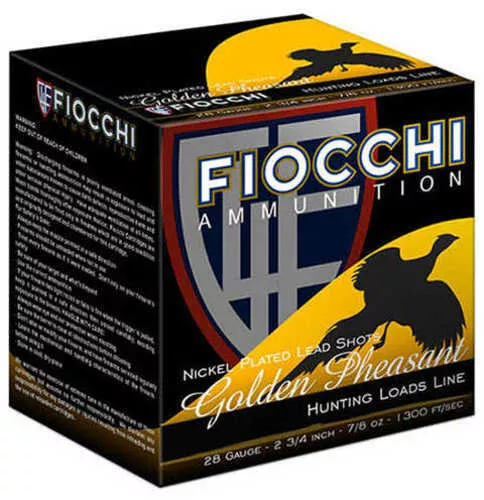
Fiocchi Extrema Nickel Plated Pheasant Loads, know to the world as Fiocchi Golden Pheasant are some of the finest loads designed for Pheasant Hunters. Golden Pheasant is a standard among professional hunters for it’s performance and incredible value. Golden Pheasant features nickel plated lead shot which ensures that the shot pellets are extra hard. When loaded with the right combination of wad, the wad protects the shot and optimizes the pattern. These pheasant loads will fly straighter and penetrate deeper. Trust the company with over 140 years of ammo manufacturing experience, trust Fiocchi Golden Pheasant on your next Pheasant hunt.
Fiocchi Extrema Golden Pheasant 283GP75
28 Gauge
3″ Length
7.5 Nickel Plated Lead Shot
1-1/16 Ounce Shot
N/A Powder Dram Equivalent
1200 fps Muzzle Velocity
Uses: Hunting Pheasant
Caliber Dictionary
The Below Information Has Been Provided From Our Gun Caliber Dictionary And Is Meant For Informational Purposes Only. It Is Not Intended to Describe The Unique Specifications For This Ammunition.The 28 gauge was introduced in 1903 by Parker Brothers, famous for double-barrel shotguns. With a nominal bore diameter of .550-inch, it is considered a “small gauge” shotgun, and 28 gauge is one of the four officlal events in American skeet. Case length is 2 3/4 inches and the standard charge is just 3/4-ounce of shot. That said, with modern shells the 28 gauge is surprisingly effective on both clay targets and upland birds. Although definitely an “expert’s shotgun,” the 28 gauge has the advantage of low recoil, can be built into very light shotguns, and is much more effective than the .410. Over the years it was kept alive mostly by serious skeet shooters, but today is often chosen by serious upland bird hunters. Because of pellet count it is most effective with smaller shot sizes (7 1/2, 8, and 9), so is rarely employed by waterfowlers. — Craig Boddington